
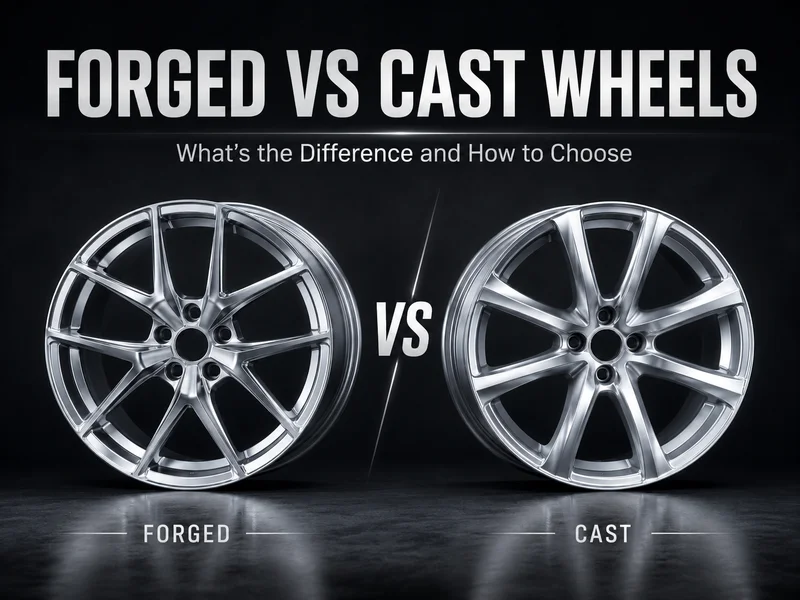
Compare forged vs cast wheels: manufacturing process, strength, weight, cost, and how to choose the right route for importers and distributors.
Forged vs cast wheels is one of the first questions every wheel buyer hits, and it is also where a lot of money gets wasted. Buyers either pay a premium for forged wheels they do not need, or they spec cast wheels for a customer who needed the extra strength. This guide explains the real difference between forged and cast wheels, what each route does well, and how to match the right one to your market. AEG has run both routes under one roof since 2008, so the comparison below comes from production experience rather than theory.
The two names describe how the wheel is formed, and that single difference in process changes everything downstream: weight, strength, cost, surface finish, lead time and how much you can customize. Once you understand the process, the buying decision stops being a guess.
What's the Actual Difference? The Manufacturing Route
Both wheel types are made from aluminum, but they take very different paths from raw material to finished wheel. That path is what you are really paying for.
How Cast Wheels Are Made
A cast wheel begins as molten aluminum. The metal is poured into a mold that already contains the wheel shape, then it cools, solidifies and is removed from the mold. The main casting methods are gravity casting, where the metal flows in under its own weight, and low-pressure casting, where gas pressure pushes the metal into the mold for a denser result.
Casting is fast and inexpensive because the mold does most of the work. The trade-off is that molten metal can trap gas and shrink as it solidifies, which leaves microscopic porosity inside the finished wheel. That porosity is the root reason cast wheels are heavier for a given strength and more prone to fatigue over time.
How Forged Wheels Are Made
A forged wheel starts from a solid block of aerospace-grade 6061-T6 aluminum called a billet. Instead of being melted, the billet is heated and compacted under a 10,000-ton forging press, which squeezes the metal grain into a dense, aligned structure. The blank is then flow-formed, heat-treated to T6 condition and cut to its final shape on multi-axis CNC machines to a tolerance of about 0.02 mm.
Because the metal is worked rather than melted, a forged wheel has no internal porosity and a grain structure that follows the wheel's shape. That is the physical reason forged wheels are stronger and lighter for the same dimensions. It is also why they cost more: more material is wasted, more machine time is required, and more process steps are involved. You can see the full sequence on our forged aluminum wheels manufacturing page.
Where Flow Forming Fits In
Flow forming sits between the two. The wheel face is cast first, but the barrel is then spun while high-pressure rollers stretch and compress the rim. This work-hardens the aluminum and creates a barrel that is lighter and stronger than a conventional cast barrel, at a lower cost than a fully forged wheel [1]. For buyers who want forged-like weight on a cast-like budget, flow forming is often the sweet spot. Our cast aluminum wheels range includes flow-formed options for exactly this reason.
Forged vs Cast Wheels: The Key Comparison
Here is the comparison, without the sales talk.
| Dimension | Forged Wheels | Cast Wheels | |-----------|---------------|-------------| | Starting material | Solid 6061-T6 aluminum billet | Molten aluminum | | Primary forming | 10,000-ton forging press | Mold filling and solidification | | Internal structure | Grain-aligned, no porosity | Possible micro-porosity | | Weight | Lighter for the same strength | Heavier for the same strength | | Strength | High, subject to design and validation | Application dependent | | Cost | Higher | Lower | | Typical use | Performance, premium, demanding loads | OEM, aftermarket, volume programs | | Customization | High, subject to tooling review | High, subject to mold review |
The table makes the point plainly: neither route is better overall, each one suits a different job.
Strength and Weight: Why Forging Wins on Paper
If you only look at the spec sheet, forging wins. The 10,000-ton press and the T6 heat treatment produce a wheel that is both stronger and lighter than a cast wheel of the same size, because the metal grain is aligned and there is no porosity to act as a crack starter.
> Fact: AEG forged wheels start from aerospace-grade 6061-T6 aluminum billets, compacted on a 10,000-ton forging press and machined to ±0.02 mm on multi-axis CNC centers.
That advantage is not cosmetic. Lighter wheels reduce unsprung weight, which improves handling, braking and fuel use. Higher strength means the wheel survives impacts and fatigue loads that would crack a cast wheel. For off-road, track and heavy-duty applications, these are functional differences that show up in warranty claims and customer complaints if you get them wrong.
Multi-axis CNC machining cuts a forged blank to ±0.02 mm, which is how the final PCD, offset and center bore are held accurate.
If your customers buy wheels for performance, load capacity or a premium image, the forged route protects them from failures and protects you from returns.
Cost and Volume: Why Cast Wheels Win on Price
Cast wheels win the moment price is the deciding factor. Gravity and low-pressure casting produce a near-net shape with far less machining, less waste and a faster cycle, so the unit cost is substantially lower. For an OEM program or a volume aftermarket line where buyers are comparing SKUs by landed cost, that gap decides the order.
Cast wheels are also the workhorse of the industry for a reason. A well-controlled cast wheel, made from certified material and inspected properly, performs reliably in normal passenger-car use for the life of the vehicle. That control depends on the mold, the pour and the inspection that follows.
> Fact: Every AEG wheel passes 12 inspection steps with 100% full inspection and a 720-hour salt-spray test, certified to TÜV, VIA, JWL, ISO 9001, IATF 16949 and DOT.
That inspection is what separates a cast wheel you can build a business on from one that generates complaints. Whether the route is forged or cast, the quality control has to be the same, and buyers should ask to see the inspection record, not just the price.
How to Choose: Matching the Route to Your Market
Stop asking which wheel is better. Ask which wheel fits the customer in front of you.
Choose Forged Wheels When...
Your buyers sell performance, off-road, SUV or premium fitments where strength, weight and image matter more than price. Forged wheels carry the higher price point your customers will pay, and the weight savings and durability protect your reputation on demanding applications. If you are building a performance or private-label series, OEM and ODM wheel customization is where the forged route really earns its margin.
Choose Cast Wheels When...
Your buyers compete on price and move volume, the typical OEM and mainstream aftermarket situation. Cast wheels give you a competitive landed cost and a broad size range, and a properly controlled cast wheel is more than adequate for standard passenger vehicles. This is also the route to start with if you are testing a new market or a new size range without committing large capital.
When Flow Formed Is the Middle Ground
Flow forming is the compromise that has taken over a big slice of the aftermarket. It gives you a lighter, stronger barrel than conventional casting at a cost closer to cast than forged. If your customers want performance looks and weight without a full forged price, flow-formed wheels are usually the answer.
> Fact: AEG manufactures forged and cast aluminum alloy wheels at a 120,000 m² production base with 12 lines and an annual capacity of 2.6 million wheels, exporting to 36 countries since 2008.
The practical advantage of working with a supplier that runs both routes is that you do not have to guess which one you need. You can mix forged and cast lines in a single container, serve a performance customer and a volume customer from the same partner, and adjust the mix as your market changes.
FAQ
Are forged wheels stronger than cast wheels?
Yes. Forging compacts the aluminum billet under a 10,000-ton press, which aligns the metal grain and removes the porosity that casting leaves behind. For a comparable size, a forged wheel generally withstands higher impact and fatigue loads than a cast wheel. The difference matters most in performance, off-road and heavy-load applications where a wheel failure is expensive or dangerous.
Are forged wheels worth the extra cost?
Only if your customers use them hard. For performance brands, off-road and SUV fitments, the strength and weight savings justify the premium. For volume passenger-car programs where price is the deciding factor, cast wheels usually deliver better value. The right answer is decided by the application and the market, not by the word forged on the label.
What is the difference between forged and cast wheels?
The difference is the forming process. Cast wheels start from molten aluminum poured into a mold. Forged wheels start from a solid 6061-T6 billet that is pressed into shape under extreme pressure, then CNC machined. That difference in process changes grain structure, weight, strength, surface finish and cost.
Are forged wheels lighter than cast wheels?
Yes, generally. Because forging produces a denser, stronger material, the wheel can be machined with thinner walls and a lighter profile while still meeting strength targets. A forged wheel can weigh noticeably less than a cast wheel of the same size and load rating. The exact saving depends on the design and specification.
What are flow formed wheels?
Flow forming is a middle route between casting and forging. A cast wheel face is mounted on a machine that spins the barrel while high-pressure rollers stretch and compress it. This work-hardens the rim, so a flow-formed wheel is lighter and stronger than a conventional cast wheel, at a lower cost than a fully forged wheel.
How are forged wheels made?
A forged wheel starts as a solid 6061-T6 aluminum billet. The billet is heated and compacted in a 10,000-ton forging press, then flow-formed and heat-treated to T6 condition. Multi-axis CNC machines then cut the design to a tolerance of about 0.02 mm. The result is a dense, grain-aligned wheel with no internal porosity.
Do forged wheels last longer?
Under comparable conditions, forged wheels tend to resist cracking, bending and fatigue better than cast wheels, which means a longer service life in demanding use. They are also easier to repair. In normal passenger-car use, however, a well-made cast wheel can last the life of the vehicle, so the durability advantage of forging mainly shows up under hard conditions.
Which is better for my car: forged or cast wheels?
It depends on how you use the vehicle. For daily street driving on good roads, quality cast wheels are usually sufficient and more cost-effective. For track use, heavy loads, rough terrain or a performance image, forged wheels are the better choice. Buyers who stock both routes can serve every segment from one supplier.
Conclusion
Forged vs cast wheels is not a contest with a single winner. It is two manufacturing routes, each built for a different buyer. Forging gives you strength, low weight and a premium product for demanding applications. Casting gives you cost, volume and a practical product for mainstream programs. Flow forming gives you a workable middle ground.
The mistake to avoid is picking a route without looking at the customer who will buy the wheel. Decide the application and the market first, and the manufacturing route will follow almost by itself.
If you are deciding between routes for a specific program, send the sizes, PCD, offset, quantity and target market. Our team will come back with a recommendation that matches the route to your market, and a transparent quote. Request a quote to start the conversation.
Sources
- Total gaps: 0 | Resolved: 1 | Unresolved: 0
- Authority breakdown: Reference 1 | Industry 0 | Government 0
- Wikipedia. "Shear forming / Flow forming." Wikipedia, The Free Encyclopedia. forming">https://en.wikipedia.org/wiki/Flowforming. Defines flow forming as a metal-spinning process that produces lightweight components with improved mechanical properties, the technical basis for the flow-formed wheel route described in this article.
Manufacturer specifications: AEG production capacity, forging press tonnage, machining tolerance, quality-control steps and certifications are stated per manufacturer specifications on https://aegautopart.com/ (brand profile: companies/aeg.yaml).